UXPro.ca
In October 2026 I rebuilt uxpro.ca, the site for my independent design consulting, from a Framer template into a custom Next.js build — end to end with AI agents in parallel lanes and a second model reviewing each pass. Mobile performance went from 48 to 97, an axe sweep of 15 pages found no violations, and the site publishes its own dated audit, failures included.
- Role
- Design and build direction — information architecture, design, AI agent lanes, performance, accessibility, SEO, launch
- Timeline
- Audit of the old site on 16 Sep 2026; the new site went live in October 2026.
- Year
- 2026
- Lighthouse mobile performance, old Framer site vs. new home page
- 48 → 97
- Largest paint on a simulated slow phone, home page
- 13.8 → 2.3 s
- axe accessibility violations across 15 audited pages
- 0
- Tools
- Figma · Next.js · Vercel · Claude Code +5
- Type
- Website · Performance · SEO & AI search
00 · TL;DR
The thirty-second version.
Six lines on UXPro.ca. The chapters below show the work behind each one.
- Role
- Designer and build lead on my own consulting site: I set the direction, made the design calls and directed the build.
- Team
- I designed it and directed the build; AI agents built in parallel lanes and a second model reviewed each pass. Nothing merged without my decision.
- Timeline
- Audit of the old site on 16 Sep 2026; the new site went live in October 2026.
- Scope
- Information architecture, interaction design (a configurator that hands its selection to the enquiry form), a 72-second film, performance, SEO and AI-search plumbing, accessibility, launch verification.
- What I decided
- Say the whole scope on the first screen and make the method a first step, not the identity. Gate every merge on a build, a check and my decision. Publish the audit with the failures left in.
- Outcome
- Home page mobile performance 48 → 97 (old site 16 Sep, new site 19 Oct 2026), largest paint 13.8 s → 2.3 s, 0 axe violations across 15 pages. Two of the site’s own checks still fail, in public.
Chapter 01 of 13 · Overview
Rebuilding a production site, end to end, with AI agents
uxpro.ca is the website for UXPro, the name I use for independent design consulting. Until October 2026 it was a Framer template: slow on a phone, hard for a crawler to read and vague about what it was. I rebuilt it as a custom Next.js site, end to end — information architecture, design, build, performance, accessibility and search.
I set the direction, made the design calls and directed the build. AI agents built in parallel lanes and a second model reviewed each pass; nothing merged without my decision. This case is about that way of working, and about what it takes to make a small production site genuinely fast, accessible and readable by machines.
Chapter 02 of 13 · The problem
What the old site was doing
On 16 September 2026 I audited the Framer site the way I would audit any production site. Lighthouse on a simulated mid-range phone scored performance 48, with the largest paint at 13.8 seconds and a 2.7 MB page. The hero headline was gated behind an animation, so a crawler often saw no headline at all.
- Template leftovers in search results: case studies titled “Newsbook – Framer Template”, every blog post dated 25 July 2023.
- Junk pages in the sitemap and two pages sharing one title.
- A first screen that tried to cover startups, SaaS, barbershops, pitch decks and logos in the same breath, in a mix of “I” and “we”.
- No structured data beyond the home page, and nothing an AI assistant could quote with confidence.
- Lighthouse mobile performance, old site
- 48
- Old Framer home page, 16 Sep 2026
- Largest contentful paint, old site
- 13.8 s
- Simulated mid-range phone
- Layout shift, old site
- 0.22
Chapter 03 of 13 · Information architecture
Say what it is on the first screen
The first drafts led with a method — “We redline websites.” It worked as a line and failed as a first screen: read cold at phone width, it sounded like the only thing on offer. The rewrite says the whole scope in one sentence, and the method moved down to where it belongs: a first step, not the identity.
Chapter 04 of 13 · Interaction design
A configurator, not a price list
The quote page is a small piece of product design: tiers as tabs, every row compared, add-ons as toggles, and a summary card that updates as you choose. The selection travels into the enquiry form, so nothing has to be typed twice.
Chapter 05 of 13 · Content design
Every piece of work says what it is
A portfolio blurs easily. Every study on the site carries a label that leads its summary — client project, client work anonymised at the client’s request, studio concept, or ongoing practice — and a page says what each label means. A concept has no client and no measured result, and says so before you see it.
Chapter 06 of 13 · Motion & film
Make it make sense
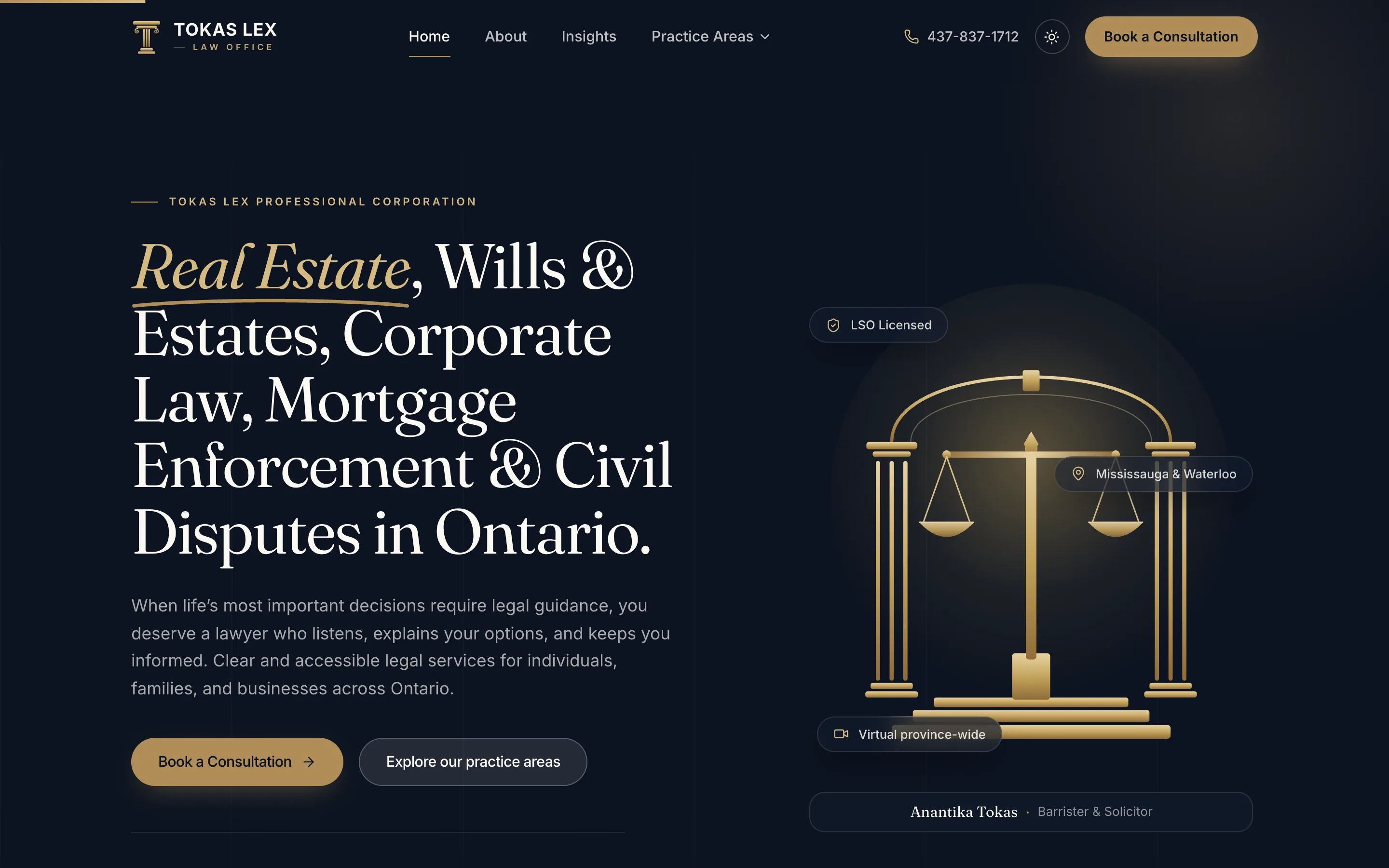
I made a 72-second narrated film that shows the range quickly: websites, a redline, products and apps, brands and pitch decks. It opens and closes with an imagined client chat — labelled as imagined, with no client named. Every piece of work in it is labelled the same way the site labels it, and the film page carries the full narration and a scene-by-scene text version.
Read it instead — the text version
Scene by scene: an imagined chat — “The idea is there. It just doesn’t look right yet.” A hard cut to MAKE IT / MAKE SENSE., the title snapping into alignment. Websites: the live Tokas Lex site, then two studio concepts. The redline: a flawed studio-concept page marked up in red, then snapping to the finished version. Products and apps: Tandem on a phone, then Stride (anonymised client work). Brands and pitch decks: Latitude and Still Measure (anonymised client work), then Funded deck studies. The chat returns: “It finally makes sense.” The UXPro mark and hello@uxpro.ca.
The film is composed as HTML and rendered to video, so a change to the work is a change to a file rather than a re-edit. The narration is a licensed generated voice; the hand-held device and surfaces are generated mockups, and the page says so.
Chapter 07 of 13 · SEO, AEO & GEO
Built to be read by people, search engines and assistants
Small businesses are found by a search or, increasingly, by an assistant’s answer. So the site carries structured data across its pages, an llms.txt and plain-language guides that an assistant can quote.
Chapter 08 of 13 · Accessibility
Accessible by default, and checked
Ontario sites work under AODA. This one targets WCAG 2.2 AA, honours reduced motion, reads with JavaScript turned off and is fully usable from a keyboard. An automated axe sweep across fifteen key pages found no violations; the accessibility statement lists the known gaps and how to report a barrier.
Chapter 09 of 13 · Proof
The audit, published
The site’s own checklist runs on uxpro.ca and is published, with every reading dated — and the failures stay in. On the live site the home page reads 2.3 seconds to the largest paint on Lighthouse’s simulated slow phone, performance 97, with accessibility, best practices and SEO at 100. The quote page reads 2.6 seconds, over the site’s own 2.5-second gate, so it is marked as a failure until a later reading shows it inside.
- Mobile performance, home
- 97
- New site, median of three runs, 19 Oct 2026
- Largest paint, home
- 2.3 s
- Simulated slow phone
- Accessibility, best practices, SEO
- 100
Chapter 10 of 13 · Launch
Launch, and the plumbing behind it
Before launch, a verification script crawled every sitemap URL, every link and every redirect from the old Framer addresses. Enquiries go through Resend to an inbox with a parallel copy in Airtable; I put real submissions through every path on the live site, including the configurator hand-off, and recorded them on the proof page.
Launch week,counted, not described.
- URLs in the sitemap
- 130
- Launch verification, 26 Oct
- Launch-check fetches
- 1,508
- 0 failures
- Pages with JSON-LD
- 128
- 0 errors
- Pages through axe
- 15
- 0 violations
Every figure is on uxpro.ca/proof with its date. The crawler figure is from the launch run log.
Chapter 11 of 13 · Process
How the work actually got done
This was also a test of how I want to work. I wrote the briefs and made the calls; AI agents did the building in parallel lanes; a second, independent model reviewed each pass and scored it before anything merged. Nothing shipped on an agent’s say-so — every lane ended in a build, a check and a human decision.
- 01
- One brief per lane, with acceptance criteria written before the work started.
- 02
- An independent review round after each pass, with the findings fixed or argued with in writing.
- 03
- A launch-verify script, an accessibility sweep and a Lighthouse run as the gate, not a feeling.
Chapter 12 of 13 · Next
What’s next
Bring the quote page inside its own speed gate, decide whether the script budget is the right measure, and cut the film down for social.
Chapter 13 of 13 · Final work
Every screen, as it went live.
Forty captures of the live site at 1440 and 390 px, taken 28 October 2026. Open any of them full size; arrow keys step through.
- Home
- Home — services
- Home — services detail
- Home — tiers
- Services
- Services — reviews
- Services — places
- Configurator
- Configurator — compare
- Configurator — care plans
- Redline — request
- Redline — steps
- Redline — full
- Work — index
- Work — concept card
- Work — labels
- Proof
- Proof — checks
- Proof — dates
- Film
- Film — text version
- About
- About — story
- About — launch
What shipped
- A custom Next.js site replacing a Framer template, live October 2026.
- Built in parallel AI agent lanes, with an independent model review and a human decision before every merge.
- A dated public audit of the site — including the checks it still fails.
- A 72-second narrated film with captions and a scene-by-scene text version.